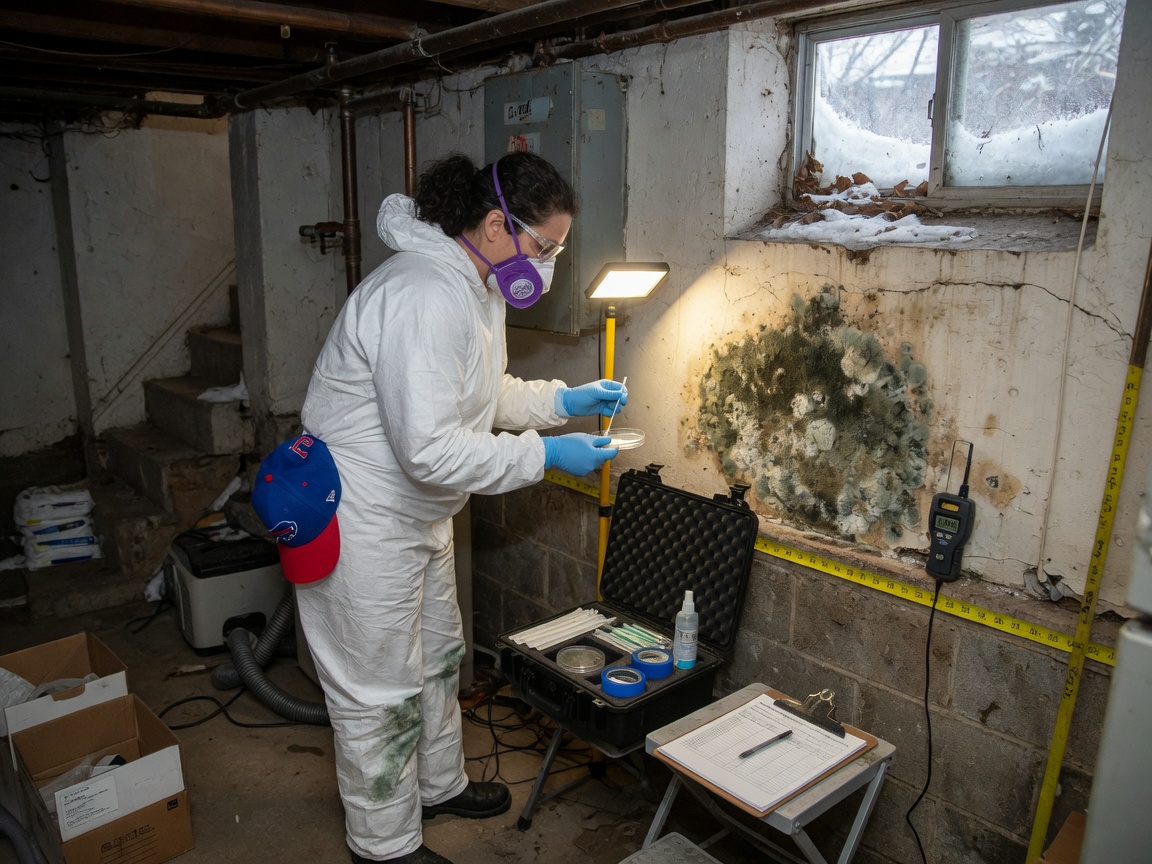
Mold testing should answer a specific question: whether suspicious growth is mold, whether hidden moisture has affected adjacent materials, or whether indoor conditions differ meaningfully from outdoors. In Buffalo, heavy lake-effect snow, spring thaw and humid summers can expose weaknesses around foundations, roof edges, attic bypasses and masonry walls. We begin with the building, not a row of sample cassettes. A visual and moisture assessment helps identify wet drywall, damp sill areas, condensation on cold surfaces and staining that may be inactive. Testing without this context can produce laboratory numbers that sound precise but do not identify the water source or define a useful response.
Older wood-frame and masonry housing found across Allentown, Elmwood Village, Black Rock and South Buffalo requires careful interpretation. Plaster, wood lath, rubble or masonry foundations and layered renovations can conceal moisture paths that are not obvious from the finished room. In North Buffalo and University Heights, attic condensation may be tied to warm indoor air leaking around ceiling penetrations rather than a roof leak. Riverside and Lovejoy basements can also show efflorescence or mineral staining that resembles biological growth. Surface samples can help identify visible material, while air samples are more useful when selected rooms can be compared with a representative outdoor control.
Sampling is not automatically necessary when visible mold and an active leak already establish the need for corrective work. It becomes more valuable for uncertain staining, suspected hidden contamination, post-remediation evaluation or documentation requested during a property transaction. New York regulates mold assessment and remediation on covered projects, including separation between the assessor who writes the plan and the contractor performing remediation; statutory thresholds and exemptions can apply. Testing should therefore produce clear locations, methods and laboratory findings rather than a vague pass-or-fail statement. Results must still be interpreted alongside moisture readings, ventilation conditions and what was observed during the inspection.
Service is available across Erie County, including Buffalo neighborhoods from Broadway-Fillmore and Kaisertown to Elmwood Village and Riverside, as well as nearby Amherst, Cheektowaga and Niagara Falls. Properties near Canalside, Delaware Park, Buffalo City Hall, the Albright-Knox Art Gallery and the Buffalo Niagara Medical Campus can differ substantially in construction and occupancy, so the sampling plan should match the building rather than a standard package. Keep windows, HVAC operation and recent cleaning activities consistent before testing when instructed, because unusual ventilation or aggressive cleaning can distort a snapshot. Business hours are Monday through Friday, 8 a.m.–6 p.m., and Saturday, 9 a.m.–2 p.m.
Technician insight
In Buffalo, the thing that catches most people out with mold testing is assuming every attic stain came from a roof leak. In older Erie County homes, warm air escaping around ceiling penetrations can condense on cold roof sheathing during lake-effect snow season. If that airflow problem is not examined, a sample may identify mold but still miss the reason it developed.
Mold Testing Services We Offer
✓Residential Mold Inspection and Testing
A visual, moisture-focused evaluation with targeted samples where results will clarify conditions. This is suited to Buffalo houses with basement odors, recurring staining or concerns after a leak.
✓Air Quality Mold Sampling
Indoor air samples are compared with an outdoor control and interpreted in the context of room use, ventilation and visible conditions. Sampling locations are chosen to answer a defined concern rather than simply increase the sample count.
✓Surface Mold Sampling
Tape-lift or swab sampling can identify suspicious growth on drywall, framing, plaster or other materials. It is especially useful when staining could be mold, soot, dirt or mineral residue.
✓Basement Mold Testing
Testing is paired with checks for foundation seepage, plumbing leaks, condensation and moisture held behind finished basement walls. The goal is to separate a localized issue from a broader below-grade moisture problem.
✓Attic Mold Testing
Attic assessment looks for roof leakage, bathroom exhaust discharge, blocked ventilation and warm-air bypasses before samples are selected. This helps distinguish active moisture conditions from old staining on roof sheathing.
✓Post-Remediation Verification Testing
After cleanup, the work area can be assessed for visible dust, remaining moisture and airborne conditions. Verification is most meaningful after surfaces are clean and dry but before reconstruction conceals the treated area.
✓Real Estate Mold Testing
Focused testing can document suspicious areas found during a sale or purchase without treating every discoloration as a building-wide problem. Turnaround depends on site access, laboratory processing and the number of samples.
Mold Testing Cost in Buffalo, NY
| Service | Typical Range | What Affects It |
|---|---|---|
| Visual Mold And Moisture Assessment | $150–$350 | Varies with property size, accessible areas and whether specialized moisture investigation is needed. |
| Surface Sample With Laboratory Analysis | $75–$175 per sample | Affected by sampling method, laboratory fee and requested turnaround. |
| Indoor Air Sample | $100–$200 per sample | Most investigations require more than one sample, and an outdoor control may be needed for comparison. |
| Focused Mold Testing Package | $300–$700 | Typically reflects an assessment plus a limited number of air or surface samples; larger or multi-zone buildings cost more. |
| Post-Remediation Verification | $250–$650 | Depends on containment zones, inspection scope, sample count and applicable project documentation. |
Ranges are typical for Buffalo, NY and confirmed with an exact written quote before any work starts.
How it works
- 1
Define The Concern
We discuss odors, visible staining, leaks, snow or rain events, health-related concerns and the rooms involved. This determines whether testing is likely to add useful information.
- 2
Inspect And Map Moisture
Accessible areas are visually examined, and moisture-sensitive materials are checked where conditions warrant. Construction details, ventilation and likely water paths guide the sampling plan.
- 3
Collect Targeted Samples
Appropriate air or surface samples are collected from documented locations, with an outdoor control used when indoor air comparisons are needed.
- 4
Review Laboratory Findings
Results are considered alongside visible conditions and moisture evidence. The explanation focuses on what the findings do and do not establish, rather than presenting spore counts without context.
- 5
Outline Practical Next Steps
You receive recommendations based on the source and extent of the concern, which may include moisture correction, limited cleaning, further investigation or a formal remediation assessment where applicable.
Pricing
Mold testing cost depends mainly on the site assessment, number and type of samples, laboratory fees, property size and access to attics, crawlspaces or finished basements. A focused inspection with one suspicious surface costs less than multi-room air sampling; request an upfront scope so you know which laboratory charges are included.