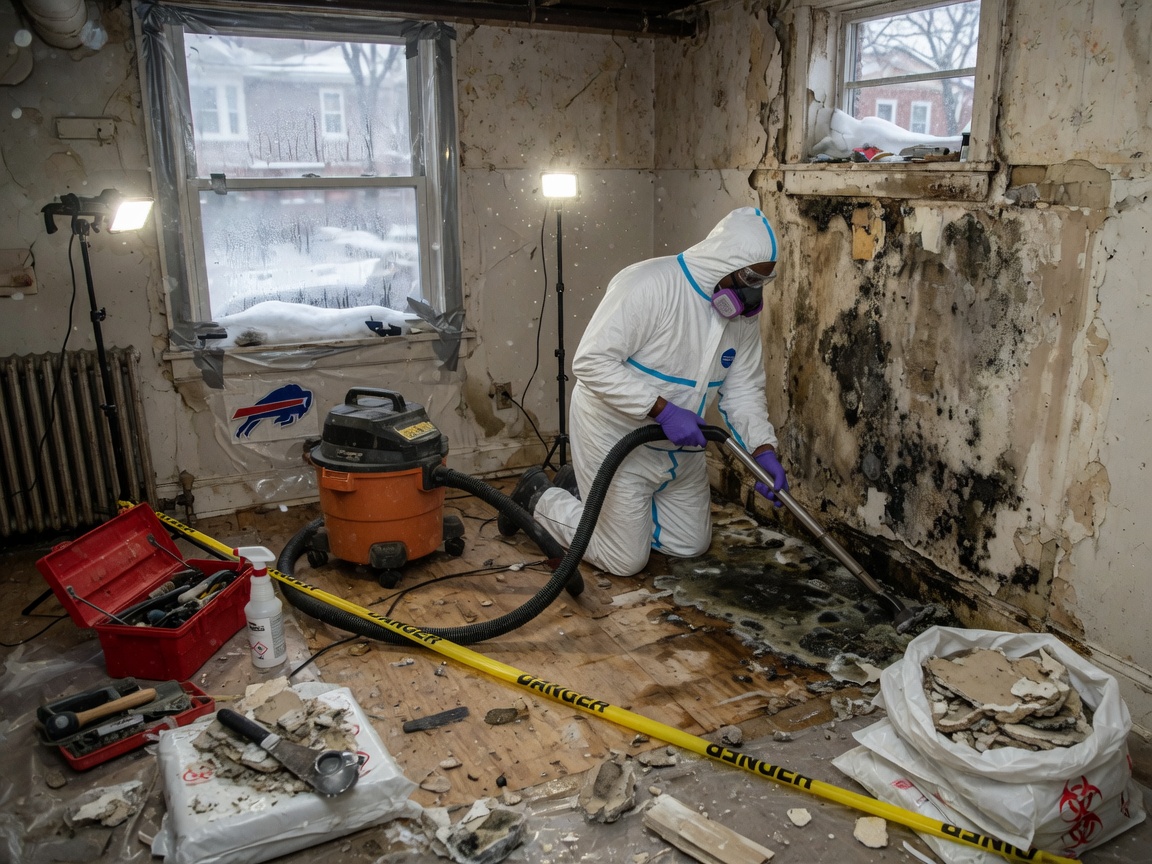
Mold Remediation Buffalo provides mold remediation in North Collins, NY, including properties near School Street, Main Street and the village center. North Collins has a mix of older village homes, rural residences, barns and buildings with basements or crawl spaces. These structures require careful attention to foundation seepage, roof leaks, attic condensation and moisture hidden behind finished walls. The process starts by identifying and correcting the moisture source, then containing affected materials so spores and debris are not carried into clean rooms during removal.
North Collins sits in southern Erie County, where a humid continental climate and heavy lake-effect snow create recurring moisture concerns. Snow piled against foundations can contribute to seepage during a thaw, while cold roof surfaces may encourage attic condensation when warm indoor air escapes upward. Larger rural lots and detached outbuildings can also change equipment access and containment planning compared with dense Buffalo neighborhoods such as Allentown, Black Rock or Riverside. Service is available Monday through Friday from 8am–6pm and Saturday from 9am–2pm, with coverage extending toward Buffalo, Cheektowaga, Amherst and Niagara Falls.
Around * North Collins
We regularly work near:
- 📍North Collins Public Library
- 📍North Collins Junior-Senior High School
- 📍North Collins Elementary School
- 📍Marion Fricano Town Park
- 📍Main Street
- 📍School Street
Mold Remediation Buffalo NY in * North Collins — Local Notes
- •Snowmelt around North Collins foundations can expose cracks, poor grading and vulnerable basement window wells. Drying the space without correcting that water path can allow mold to return.
- •Older village homes near Main Street and School Street may have layered renovations, including finished basement walls or enclosed attic spaces that conceal damp sheathing and framing.
- •Rural North Collins properties may include crawl spaces, barns or detached garages. Each affected structure needs separate moisture-source evaluation and a containment plan suited to its access points.
- •Lake-effect snow and winter temperature swings can produce roof leaks, ice-related moisture and attic condensation. Roof decking and insulation should be checked when staining appears below upper ceilings.