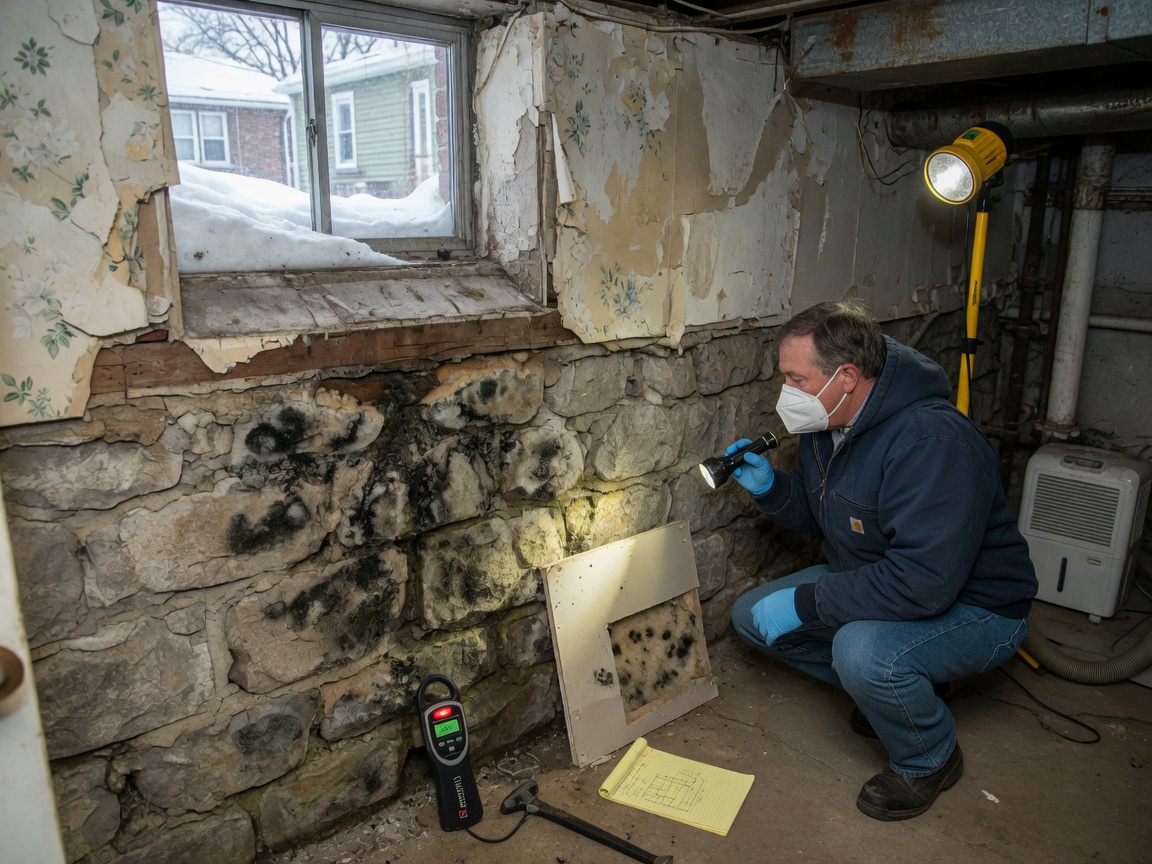
Mold Remediation Buffalo provides mold remediation in Hamburg, NY, including the Village of Hamburg and surrounding parts of ZIP 14075. Homes near Main Street and the Hamburg Village Historic District often include older basements, masonry foundations and enclosed wall cavities that require careful moisture tracing. Farther from the village core, postwar subdivisions present different concerns, such as finished lower levels, attic condensation and mold concealed behind stored belongings. We identify the moisture source, define the affected materials and explain the proposed removal scope before work begins.
Hamburg’s heavy lake-effect snow changes how mold problems develop. Snow accumulation, ice dams and wind-driven weather can introduce moisture at roofs, dormers and exterior walls; spring thaw can expose seepage around foundations or basement windows. Properties closer to the Lake Erie side of the town may also face stronger weather exposure than inland streets. We serve Hamburg from Monday through Friday, 8am–6pm, and Saturday, 9am–2pm, with mold removal options shaped around the building, access conditions and affected materials.
Hamburg is part of Erie County and sits south of Buffalo, with practical access toward South Buffalo, Kaisertown, Lovejoy and Broadway-Fillmore as well as Cheektowaga, Amherst and Niagara Falls. A Hamburg project still requires its own plan: village houses can have tighter driveways and closely spaced neighboring structures, while outlying town properties often have larger footprints and more extensive basements. The goal is not simply to clean visible growth, but to address damp materials and conditions that could allow it to return.
Around * Hamburg
We regularly work near:
- 📍Hamburg Village Historic District
- 📍Hamburg Fairgrounds
- 📍Hamburg High School
- 📍Hamburg Town Park
- 📍Main Street in the Village of Hamburg
- 📍Lake Street in the Village of Hamburg
Mold Remediation Buffalo NY in * Hamburg — Local Notes
- •Older Village of Hamburg properties may contain stone or masonry foundation walls, low basement clearances and multiple renovation layers. Inspection and containment planning must account for concealed cavities rather than treating surface staining alone.
- •Lake-effect snow and freeze-thaw cycles can contribute to roof leaks, ice-dam moisture and wet insulation. Attics, eaves, upper wall corners and ceilings should be checked when staining appears after winter weather.
- •Finished basements in Hamburg can hide seepage or condensation behind drywall, paneling and stored contents. Moisture mapping helps determine whether porous materials need removal and how far the affected area extends.
- •Access varies sharply between the compact village core and suburban parts of the town. Narrow driveways, detached garages and occupied lower levels can affect equipment placement, containment routes and debris removal.